


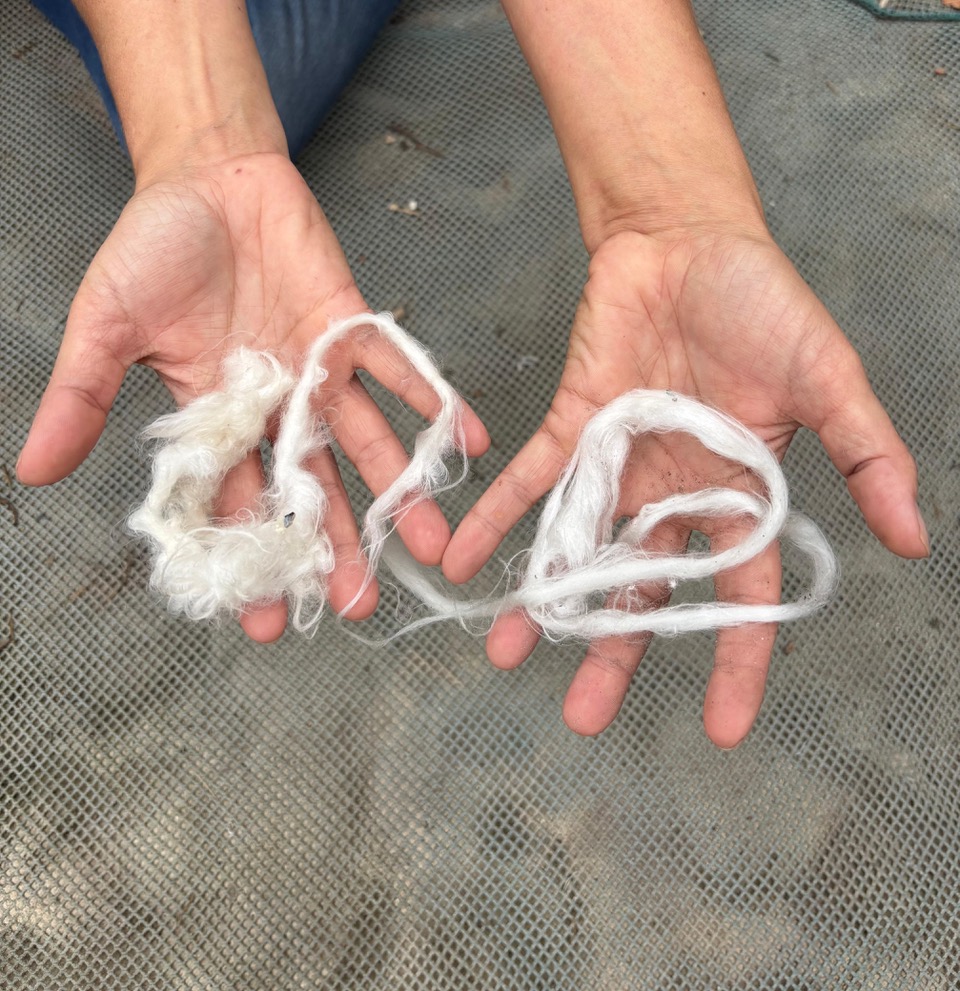
There was a meter of synthetic string wound around its beak and inside its mouth.
Gansbaai, Western Cape (07 April 2026) – Cape gannets are generally much too fast for human hands to catch. They’re built for speed with sharp eyes and razor beaks. They can outsmart even the quickest flick of a fish. This gannet, on the other hand, didn’t put up a fight when its rescuers drew closer. That’s when the crew of the Dream Catcher knew that something must’ve been awry.
The Marine Dynamics Marine Big 5 Tour vessel had been out with guests on the water near Gansbaai when the crew spotted the bird flying low, trailing what appeared to be a length of synthetic string. It landed on the surface without diving or taking off. It just sat there as they inched closer.
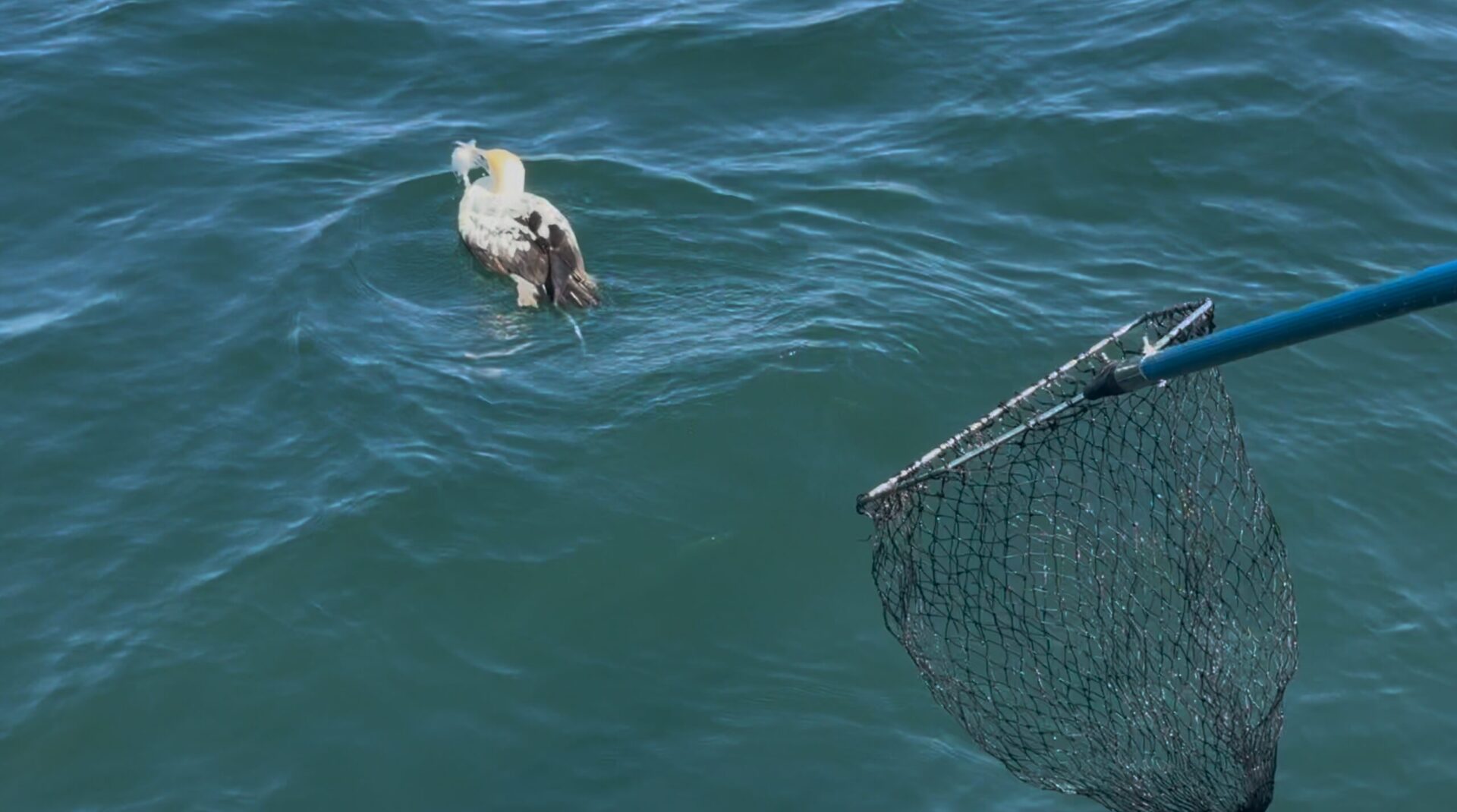
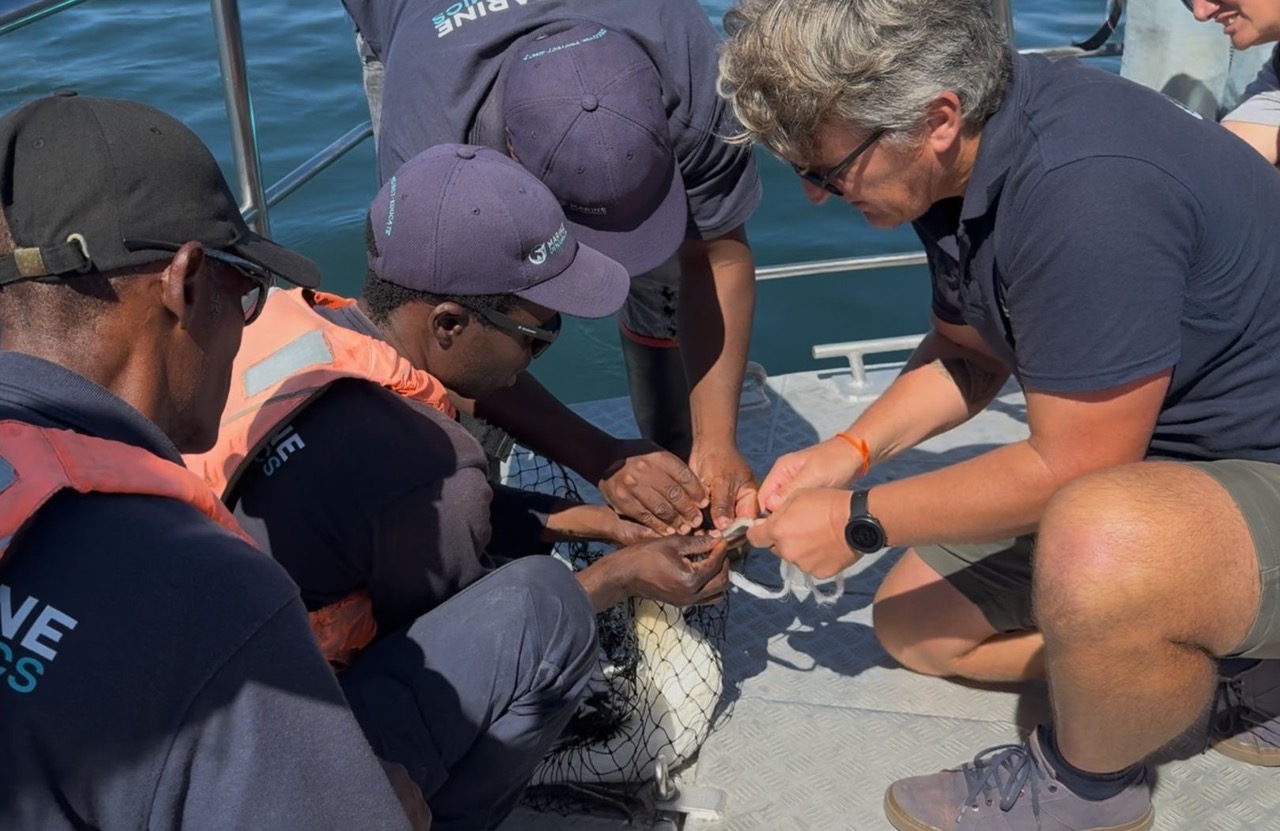
Crew members Zwelandile Matiwane, Admire Kuseka, and Leon Kriel reached for the net kept on board for these moments and scooped the bird from the water. When it didn’t resist and didn’t so much as snap, they understood how close to the end it really was.
“It was as if it was saying: ‘I’m exhausted. I haven’t been able to eat for days… maybe months. Help me.’”
Working with gentle hands, the three used a sharp knife to remove a metre of synthetic string wound tightly around the bird’s beak and lodged inside its mouth. It had likely been there for weeks or possibly months. Unable to open its beak properly, the gannet would have been unable to feed.
“Clients on this tour witnessed something I have never seen in my 25 years of marine conservation. I have seen many entangled seabirds, even gannets, but it is nearly impossible to catch and help them. This was truly amazing — but also incredibly sad that this bird was so weak we could literally scoop him up.” said Wilfred Chivell, CEO of Marine Dynamics & Founder, Dyer Island Conservation Trust.
The Cape gannet, or ‘malgas’, is endemic to southern Africa and listed as endangered. A healthy population of gannets (like the growing colony on Bird Island) is considered a good indicator of a healthy ocean, so their steady decline over recent decades, driven by overfishing and shrinking prey stocks, is a story the sea itself is telling us.
Already nutritionally stressed, Cape gannets like this one are far less equipped to survive an additional threat like entanglement in ghost fishing gear.
“Yet, like the critically endangered African Penguin, their populations have declined dramatically due to reduced prey availability, driven by overfishing and changing environmental conditions. Forced to survive on less nutritious fishery discards, many are already weakened — making threats like plastic entanglement even more deadly.”
Related Story
Chivell, who founded the Dyer Island Conservation Trust, and has spent 25 years working these waters, says this rescue was both remarkable and a reminder of the saddening reality his teams encounter regularly.
“It is heartbreaking to witness the suffering caused by entanglement. We see seals with plastic cutting through their skin and flesh – literally suffocating these animals. It is a slow, horrific death.”
The Trust has spent decades fighting back against ocean pollution through stormwater catchment programmes, education, and training crews like this one never to look away from an animal in need. That culture of readiness is what gave this seabird (and many others rescued) a second chance.
The gannet was released, if it’s spotted again showing signs of distress, it will be taken to the African Penguin and Seabird Sanctuary for further care.
Thousands of tour guests pass through Gansbaai every year to see the ocean’s wonders. On this trip, they also got to see what it looks like when the people who love our oceans refuse to turn away from the cost of our plastic habit. A habit that quite literally kills.
“This gannet was given a second chance. But how many others are out there, suffering unseen? It doesn’t matter where you live. Every river leads to the ocean. Every piece of litter has the potential to become a death sentence for marine life.”
Sadly, not every bird will have a Dream Catcher nearby. A fisherman leaving a bit of line behind, a child tossing a wrapper out the window instead of in the bin…nobody thinks their small bit of carelessness is the problem. That’s what we need to work on changing. Stories like this one can spark that awareness – even if only reaching one person. Responsibly discarding your rubbish matters!
 by
by 